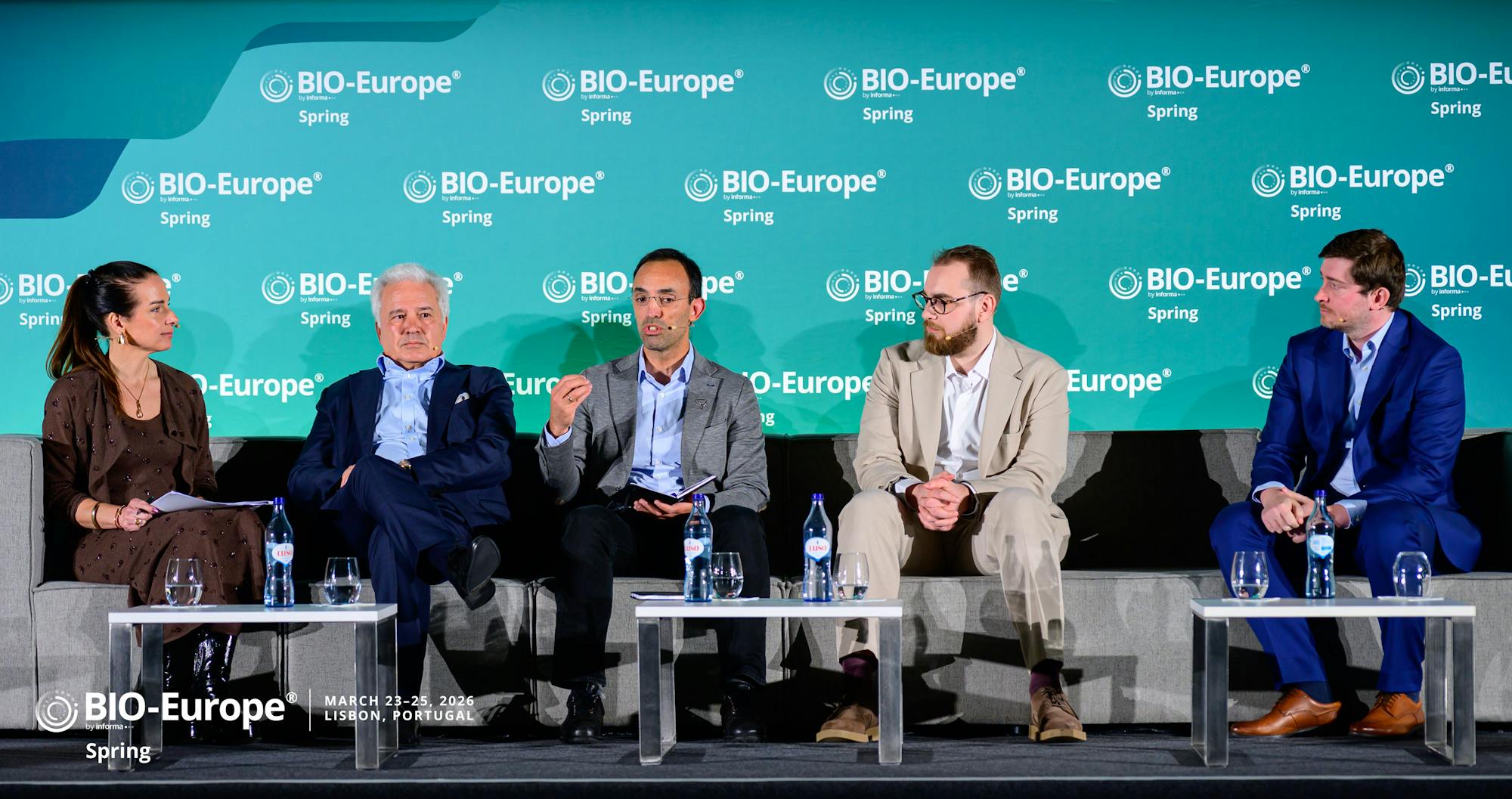
As a moderator of this session at BIOEuropeSpring, my aim was to bring together the perspectives of biotech, big pharma, AI-native tech and R&D infrastructure leaders, and move beyond the AI hype nowadays by focusing on real value and workflows.
AI is no longer just a supportive tool; it’s a strategic enabler in how biopharma sources opportunities, evaluates risk, and informs BD decisions.
Here are my key takeaways from the panel discussion:
For biotech CEOs navigating resource constraints, AI is becoming indispensable. As Carlos emphasised, AI levels the playing field by accelerating competitive intelligence, due diligence preparation, contracting, and IP analysis. Tasks once requiring weeks of manual work now take hours, enabling lean teams to move at big‑pharma speed without big‑pharma budgets.
Decision‑making remains human. AI amplifies expertise by synthesising data and surfacing insights, but complex interpretation and relationship‑driven dealmaking is best done by people. As Luciano put it, the future isn’t “human‑in‑the‑loop,” but an augmented BD leader with supercharged context and clarity.
AI is already being applied across the lifecycle, from discovery to BD diligence and dealmaking. Dmitrii highlighted an important perspective for doing this well by distinguishing between data‑oriented tasks on one end of the spectrum and judgment-oriented tasks at the other. This can be used as a helpful starting point for biotech and pharma teams to identify quick-wins or high‑value, practical use cases without overextending expectations.
When AI delivers, and when it falls short. Examples shared ranged from:
Strategic reports generated in hours instead of weeks
Landscape and competitor maps assembled in a fraction of historical time and more up to date
Contract drafting accelerated through legal‑AI models
And we discussed the importance of failures to understand the limitations. Martin stressed the importance of a “pilot‑and‑learn” culture, where multiple experiments fail so that the right ones can scale.
One of the biggest risks isn’t the AI, it’s the expectation that AI is magic. Boards and investors often assume instant efficiency gains. But as the panel stressed, responsible use requires educating stakeholders, clarifying AI’s limitations.
“Think of your AI solution as a junior analyst that accelerates work but still requires oversight”
For most companies, the shift begins with:
Breaking down data silos so AI has the right inputs
Finding early internal champions who generate visible wins
Testing multiple vendors because the market is still volatile
Scaling only what works, not what’s hyped
AI will not make deals anytime soon. But BD teams who ignore the technology risk falling behind competitors who are using AI to be faster, more informed, and more strategically prepared.
Subscribe to our newsletter for more insights.
Further reading
-
Industry
Why CMS’s Quiet Shift Toward Real-World Evidence Matters for Pharma Strategy
Why CMS’s Quiet Shift Toward Real-World Evidence Matters for Pharma Strategy
-
Announcement
Acceptance of Campfire Session at 39th ECNP Congress 2026 Highlighting Urgent Need to Rethink Development in CIAS
Acceptance of Campfire Session at 39th ECNP Congress 2026 Highlighting Urgent Need to Rethink Development in CIAS