
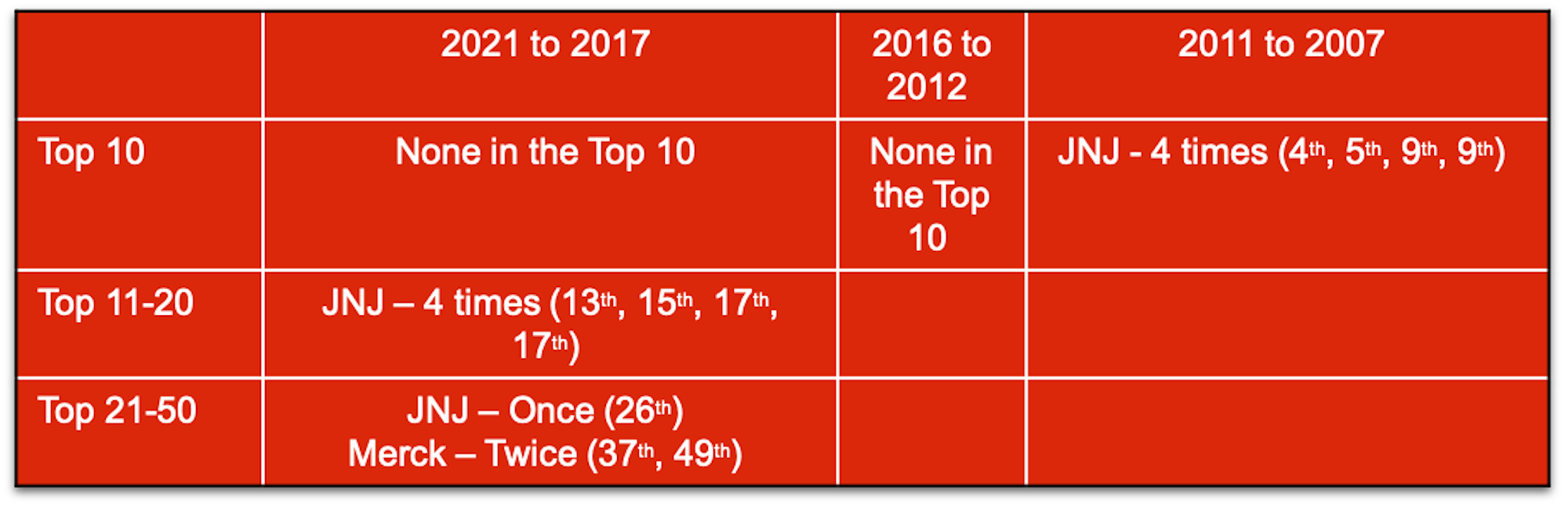
Interesting, because a retrospective look at Fortune’s charts shows us Merck & Co. made it into the top 10 seven years in a row, from 1987 to 1993.
So, what’s happening? Why aren’t leading pharmaceutical companies ranking more highly as most admired more often?
Well, Fortune’s is just one list. Fast Company’s 2021 list of the World’s Most Innovative Companies (https://www.fastcompany.com/90603436/the-worlds-most-innovative-companies-2021 ) ranked Moderna and Pfizer-BioNTech at number 1 and 2, respectively. It’s good to see those companies being recognized for the role they played in helping to quell a global pandemic.
And almost all the large pharmaceutical companies are considered financially stable according to Value Line 2 April 2021 reports (www.valueline.com). Most are predicted to see stock price growth in the middle 5th of Value Line’s basket of companies over the next 12 months and only a few are predicted to see choppier waters in the coming months and year.
If finances are looking this healthy, should pharma be worried? In this case admiration isn’t so much about a popularity contest as it is about potentially important signals about a company’s future. The Fortune rankings are about much more than financial performance. Almost four thousand industry executives, corporate directors and securities analysts complete the surveys that rank companies on multiple metrics: (https://fortune.com/franchise-list-page/methodology-worlds-most-admired-companies-2021/ )
Investment value
Quality of management
Quality of product
Social responsibility
Ability to attract talent
Stop and consider for just a moment that in the 2021 rankings companies like Target, Coca Cola, Marriott International and Visa ranked above all but one of the major pharmaceutical companies.
Does this matter? Are lower rankings in all these areas a sign of future diminished performance of the leading pharmaceutical companies?
In his letter to shareholders in the Johnson and Johnson 2020 annual report, CEO Alex Gorsky said, “Now is the time to shift the focus in healthcare away from just effectiveness and cost to sustainability, resiliency, and value.” Though these words could mean many different things to many different people, they are certainly a call for change. But change is hard. Change is especially hard for large corporations whose margins remain robust and who, compared to the market dynamics of other industries, still face relatively low pressure on pricing and a rising tide of volume from an aging population.
What pressure can drive that change?
Can internal metrics drive more meaningful innovation at the level of industries which are already well ahead in the digital revolution?
Is there sufficient training to radically improve the perceived relative quality of management?
What will cause the lines to lengthen for pharmaceutical companies at recruiting events on college campuses? What ultimately would need to change to reposition the industry in the minds of the public?
These are big questions without easy answers, but we believe cultures and capabilities focused on continuous innovation are in the center of the possible solution mix.
Subscribe to our newsletter for more insights.
Further reading
-
Announcement
Could China’s pharma revolution ultimately be good for broader healthcare innovation?
Could China’s pharma revolution ultimately be good for broader healthcare innovation?
-
Innovation
AstraZeneca up to 8th place on the Innovation Index
In 2021 AstraZeneca (AZ) is up one position, coming in at number 8 on the 2021 innovation scale, and a drop to 6th on the 2021 invention scale after holding the 1st place in last year’s Invention ranking.