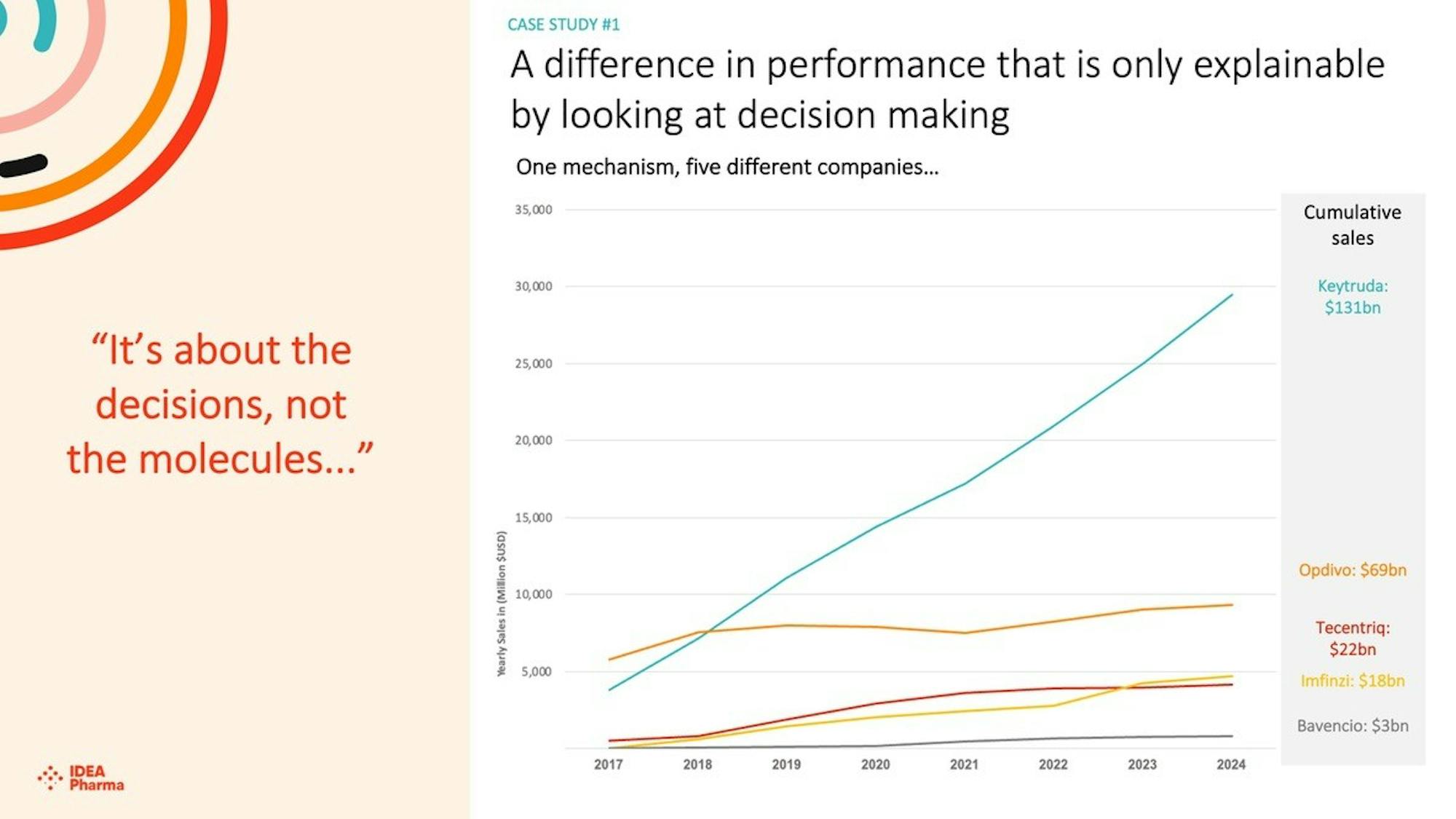
Most recently, I looked at the asymmetry in learning among the companies represented here, but I wanted now to highlight the opportunity in being second…
Thanks for reading Asymmetric Learning - Pharmaceutical Innovation ! Subscribe for free to receive new posts and support my work.
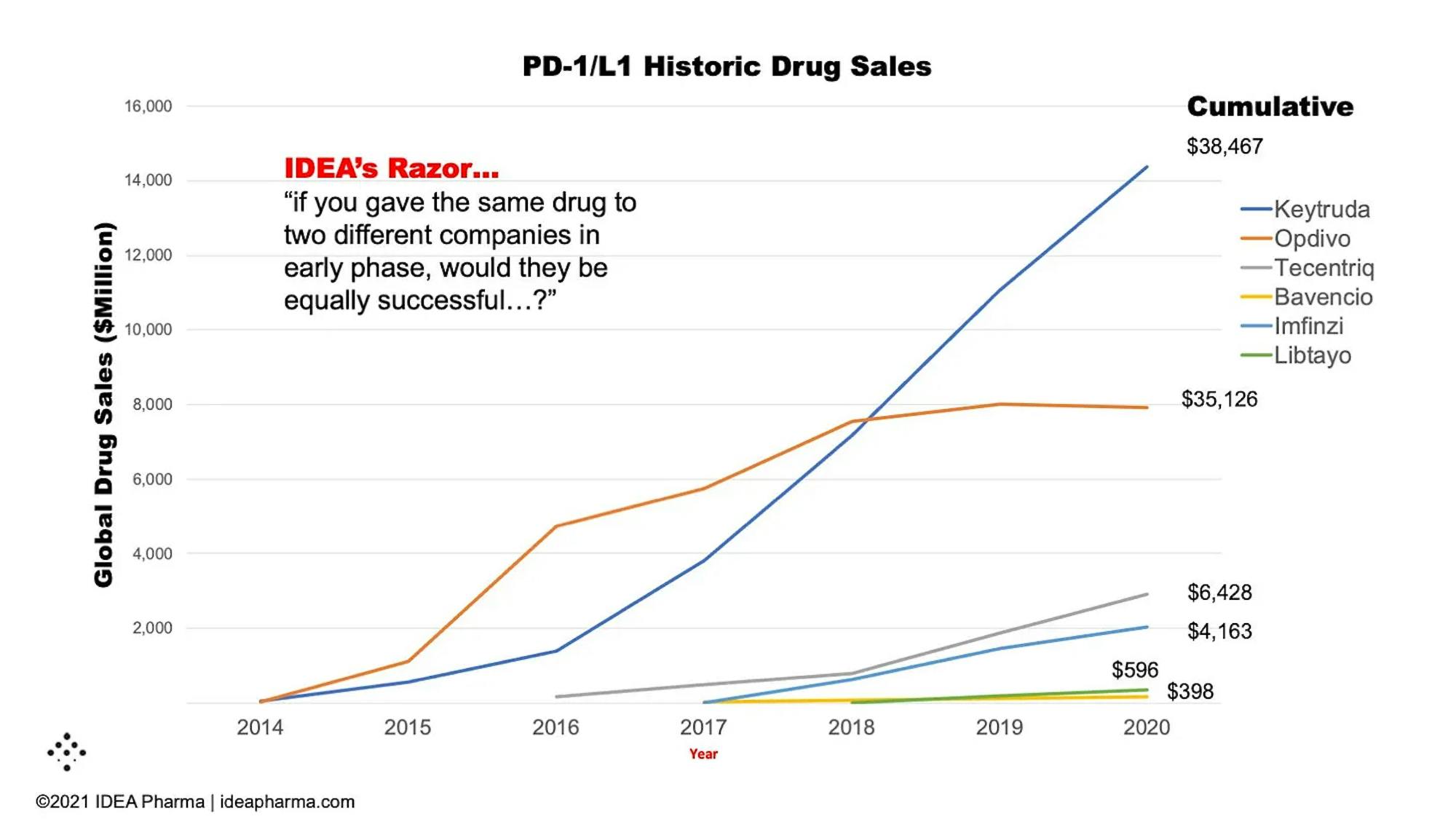
It is timely, because for a long time, in 2016 and 2017, Opdivo won. Even up to 2020, Opdivo was ahead on net revenues, as I wrote back in 2021, in ‘The $30bn question…”
As this chart (from 2021) shows, that $30bn difference between the two leaders, which showed that cumulatively they were close then, has become more than $60bn since.
Indications are that Opdivo/ BMS became conservative very quickly, protecting its lead, and losing the will to do studies that could (like their earlier PROVE-IT study for pravastatin) show their competitor doing better. Some of this makes sense - studies for overall survival are now long studies, and large if they’re going to show separation between two similar molecules: if you thought you might not win, it would be a tough sell to senior leadership. If you’re coming from behind, that decision gets easier.
I won’t dwell any longer on the PD1/PDL1 case study (although I’d love to), because we’re in another one now.
We all hear about GLP1s every day now, but it’s important to recognise the fingerprints of another case study which shows the opportunity in being second…
This first chart shows that the noise around tirzepatide reflects the dynamics - it will have overtaken semaglutide by the end of this year in year-on-year sales, coming from some way back, as little as one year ago.
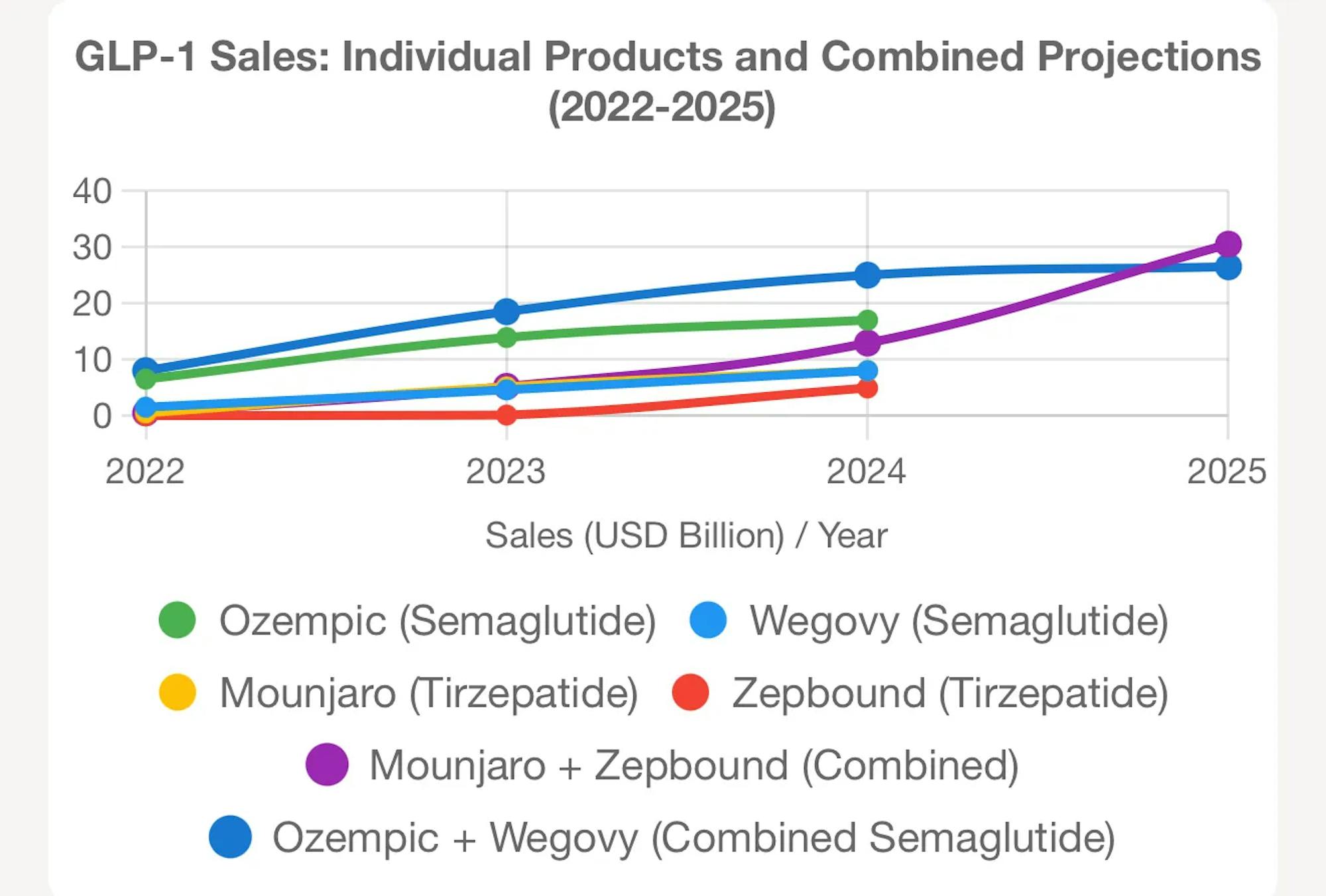
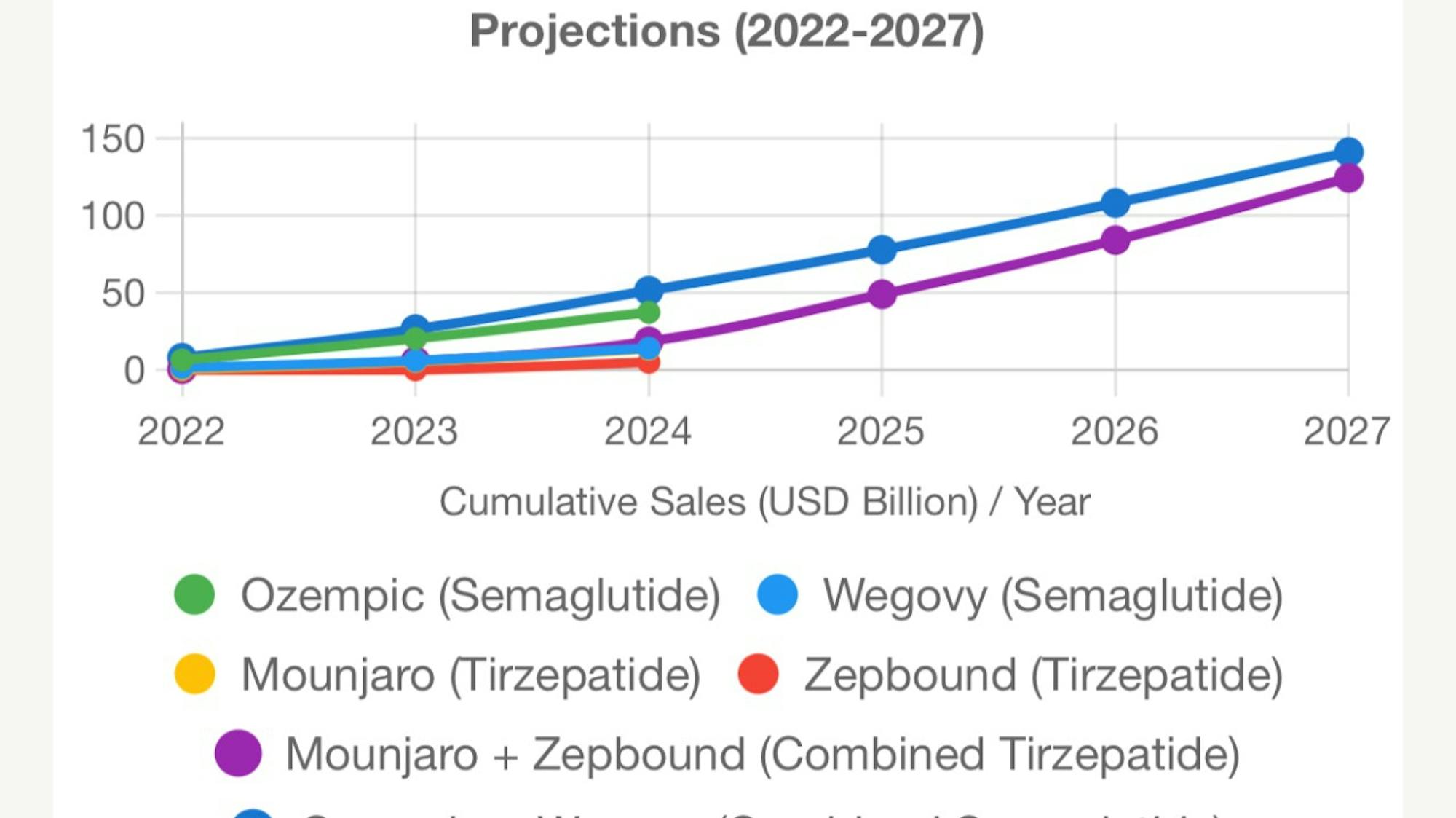
However, here, I have projected out the semaglutide family vs the tirzepatide family to end 2025 (these are the ‘best guess’ from a lot of analyst projections and the companies’ own quotes), in terms of cumulative revenue, vs annual sales.
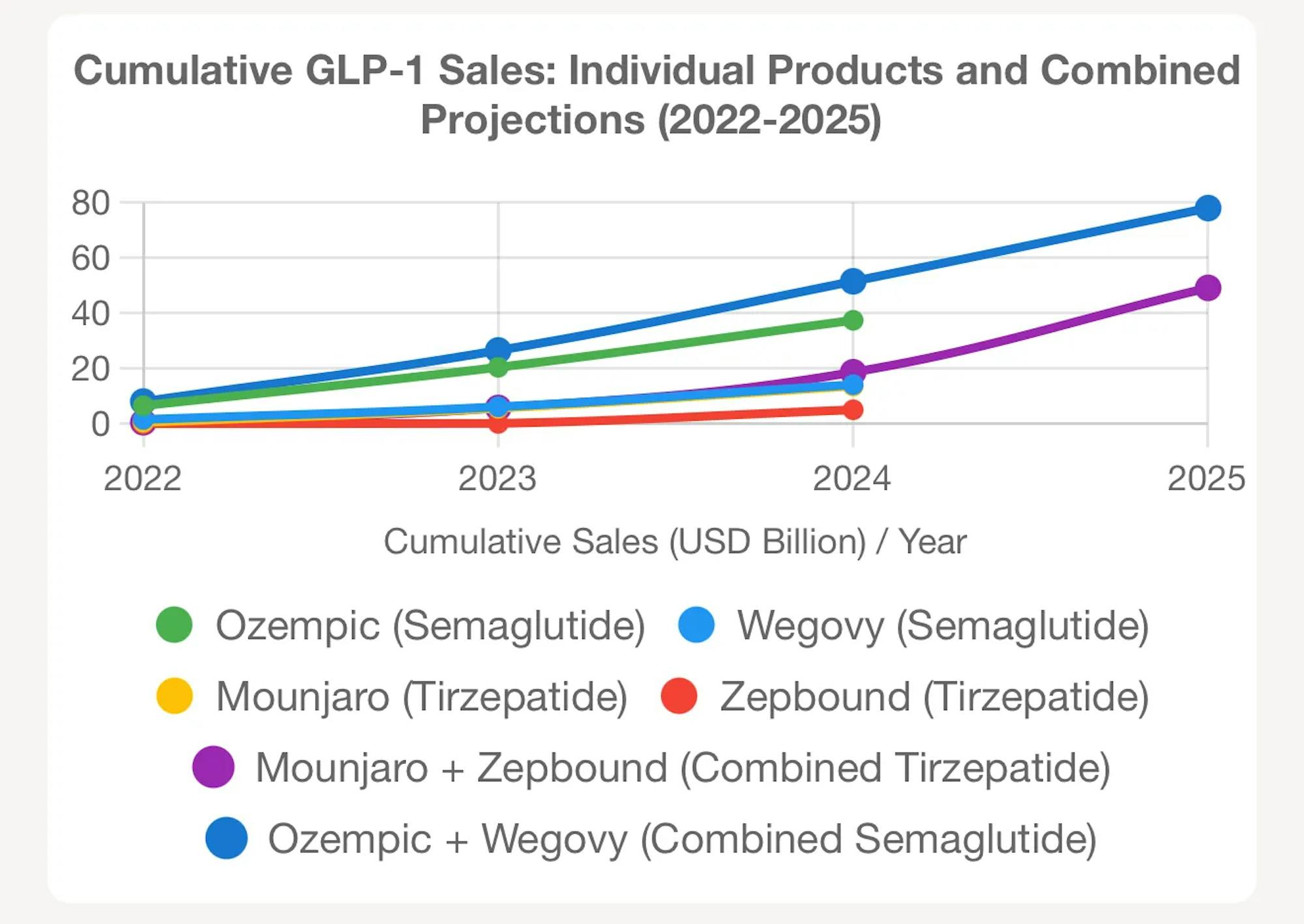
Intriguingly, Novo Nordisk benefits from its better start by staying ahead for longer than you’d think - through 2027, from the looks of the projections.
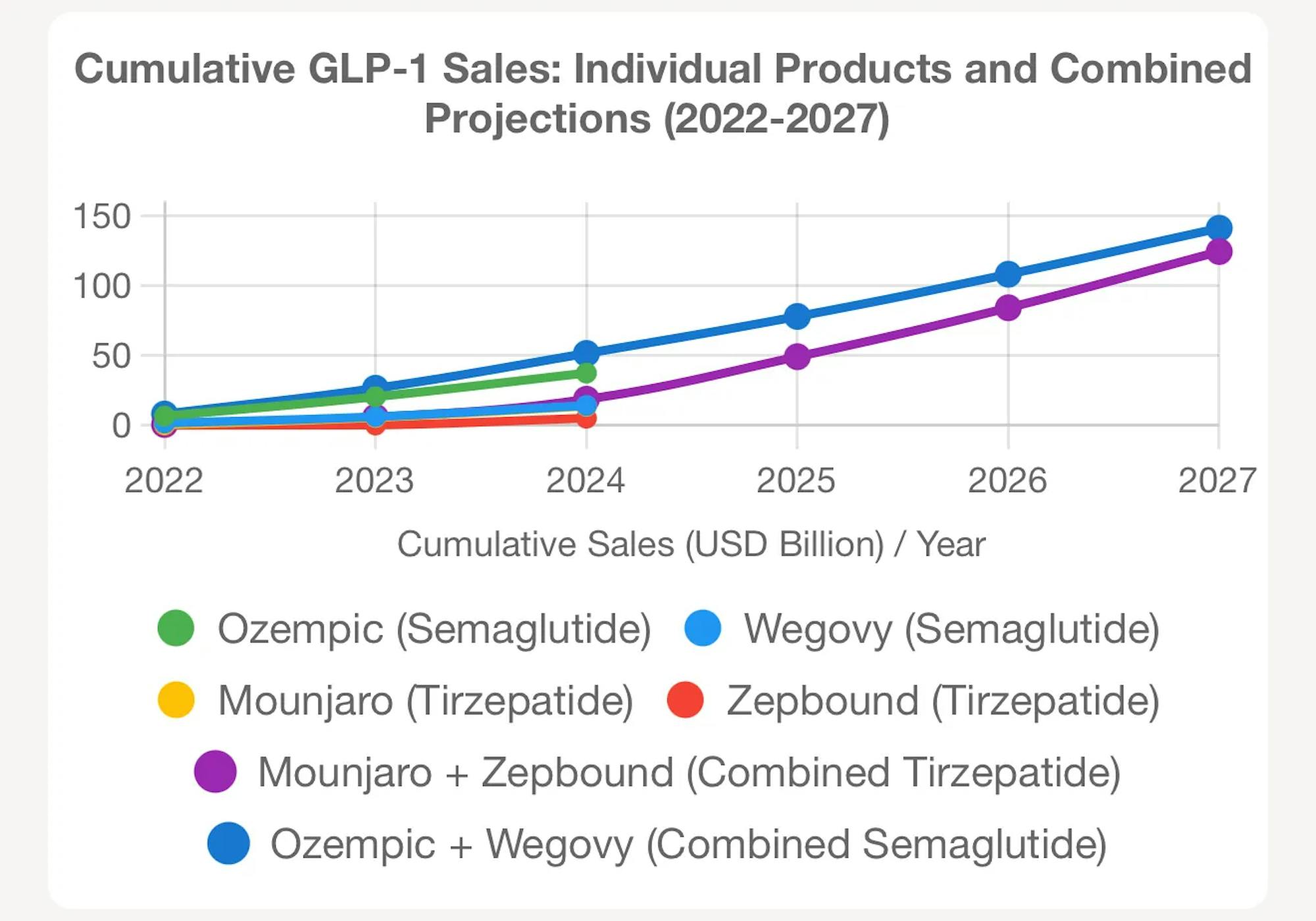
What is interesting, clearly, is what happens now. The expectation everywhere seems to be that we’ll see the same chart as the PD1 market, with semaglutide staying steady, but not seeing real growth, whereas Lilly grows year on year, to overtake on cumulative sales as we get into 2028… And these are huge drugs, expected to dwarf Keytruda’s $160bn or so.
The headline news from Novo these past few weeks is not encouraging - their massive job losses (9000 people) might save $1bn per year, but that is almost a rounding error in the revenue potential for their assets. In 2027, Lilly will see $40bn (average of projections) vs Novo’s $33bn - staying on an equal footing would more than offset the budget savings…
So, is there an advantage in being second? Lipitor was an early clue that lessons were learned by not being the first mover, Keytruda a more recent (and huge) example of risk-taking vs risk aversion - playing to win instead of protecting a lead.
Studies on drafting in cycling show that a rider positioned directly behind another (as in a lead-out scenario) experiences a substantial reduction in aerodynamic drag, typically in the range of 30-50% compared to riding solo at the same speed. This translates to equivalent savings in power output, since power requirements scale with drag at constant velocity.
Wind tunnel and field tests indicate drag reductions of around 19-32% for the trailing rider, depending on posture (e.g., upright vs. aero position).
At close separations (0.2-0.5 m, common in sprints), reductions can reach 41-66%, though this drops with greater distance or lateral offset (e.g., 27% at wider separations).
Practical estimates from pro cycling contexts suggest up to 50% effort savings when drafting closely behind a single rider, allowing the sprinter to match speeds of 60-70 km/h with far less fatigue.
In other words, you don’t want to be the front guy in a sprint. There is a ‘drag reduction’ in pharma launches too - markets are made, and expectations set, by the first in class - job 1 is increasing penetration. The second-in-class also knows what they need to beat - their ‘TPP’ is a lot easier to write than the first-in-class. The focus on beating the leader is easier in commercial too - leaders don’t like to compare themselves to others, those in second have no such qualms, so they can benefit from the penetration work of the leader, while providing a more compelling molecule on molecule differentiation.
Keytruda’s pursuit of novel indications, risky biomarker studies - an active strategy which has barely waned since - mirrors Lilly’s with tirzepatide - more granular segmentation and more, as well as more aggressive head to heads. It’s not clear whether clinically-meaningful differences are driving the GLP1 space - it has become about headline single metrics, as we saw with Keytruda, which always had the ‘most effective’ profile (we worked with Opdivo for its launch, and felt that even from there). But Lilly started 5 years behind semaglutide - there was a lot of catching up to do, so choosing the right molecule was clearly important, but an aggressive R&D strategy and commercial approach has contributed to their momentum.
3. Classic Case Studies Illustrate Second-Mover Wins
Zantac (Ranitidine) vs. Tagamet (Cimetidine)
: Glaxo's Zantac, the second H2-blocker for ulcers (launched 1983, 4 years after Tagamet), overtook via fewer side effects and aggressive marketing, becoming the world's top-selling drug (around $3B peak annual sales). Tagamet educated the market, and Zantac reaped the benefits.
Lipitor (Atorvastatin) vs. Earlier Statins
: Pfizer's Lipitor, actually the fifth statin (launched in 1996, 9+ years after Mevacor), captured double the peak sales ($13B) through superior cholesterol reduction and broad labeling. At the time, $13bn was an unbelievable number, and led many to question whether the ‘blockbuster’ era would soon be over… (I’ve a longer case study on Lipitor here… And, I’d always recommend my interview with John LaMattina , the genius behind Lipitor…)
Other Examples
Abilify (the sixth atypical antipsychotic) succeeded via broad indications
Cimzia (a late TNF inhibitor) hit $2B peak via differentiation
Eliquis (anticoagulant) won via a better safety profile
The McKonsultancies might well advise leaders to protect leads - seeing sales erode to a competitor does tend to make companies more conservative - but we would recommend that companies maintain a pioneer spirit.
We all see mindsets shift, from the anxiety of launch, to maintenance of revenues, and in that, we also believe that mindset influences decision making. There is better, and worse, decision making - knowing that we want better decision making should lead us towards the positive, competitive mindset that allows that environment to last for longer.
Subscribe to our newsletter for more insights.
Further reading
-
Innovation
Information, Intelligence, Creativity, and Asymmetric Learning: Why Curiosity Fuels Pharma’s Edge
Information, Intelligence, Creativity, and Asymmetric Learning: Why Curiosity Fuels Pharma’s Edge
-
Innovation
Purposeful Agility: Mastering the Art of Doing What Matters in Pharma
Purposeful Agility: Mastering the Art of Doing What Matters in Pharma