No need to write grants, supplies were plentiful, and the people were incredibly smart and dedicated. Research activities were supported by an army of people who ensured supplies were available, animals were cared for, and research was published.
There was just one pesky element. The whole lab headed over to the corporate cafeteria for lunch shortly after 11 AM. For a young person still functioning on student time, this was an obscene hour for lunch. So, one day, the question was asked, “Why do we eat lunch so early?” Without a moment’s hesitation, the question was answered, “Don’t want to eat lunch with the suits!” Though physically separated by only 100 yards, the R&D function and the commercial function rarely crossed paths.
Though this dynamic has improved significantly over the decades, two recent events demonstrate that the relationship is far from optimal. One, last fall, under the header of Business Models, Pharmaceutical Executive published this article, “Maximize New Product Potential Through Early Commercial Planning'. Generalization from this publication would be a disservice to the industry. There are companies that leverage the power of cross-functional teams and that fully integrate the perspectives of commercial and medical. Still, there are many leading companies that do not, and there is a reason the authors of this article thought it was an important message to send. That fact is supported by a recent statement from a senior R&D executive at a leading pharmaceutical company, and this is the second event that raises a cause for concern. This senior executive stated that they received very little value from the commercial personnel assigned to their new product teams. It was their impression that the commercial input was superfluous.
Have we stepped back twenty-plus years? Do pharmaceutical executives still need to be convinced that product development should include commercial input early and often and do R&D personnel still consider commercial leaders vacuous? How could this be? What is at the heart of this problem?
It could be an unintended consequence of success. Has pharma’s ability to maintain profits and growth with little change to their business models over the decades just locked in less than optimal processes that few other industries could afford? Scanning the 2nd quarter results of the top 20 global pharmaceutical companies and looking at the ten year-trends in Net Profit Margin in the most recent Value Line the average profitability ratios have been maintained in the high-teens and low-twenties for a decade. The biopharmaceutical industry continues to be one of the fastest-growing and profitable industries in the world. Without significant pain or need to change should it be a surprise that the disciplined processes utilized by other industries to support new product success have been eschewed by biopharmaceutical companies that simply don’t need to change?
Whilst the growth and profitability dynamic may be partially to blame; there may be another much more subtle culprit: Stage-Gate!
Phased development processes have been used in many industries for almost 100 years. The Stage-Gate Model, as most know it today, resulted from the research and development of Dr Robert Cooper. The process and supporting research were published in the mid-80s, and the disciplines of this model achieved rapid uptake by leading industrial and consumer products companies. Dr Cooper’s website claims that currently, about 80% of the Global 1000 companies have adopted this methodology. (www.stage-gate.com)
At a conceptual level, many/most of the findings of Dr Cooper’s research and the disciplines underlying the Stage-Gate Model are very applicable to the biopharmaceutical industry. The industry began using this model in the mid-to-late 90s through the early 2000s. This adoption coincided with a period of radical growth within the industry from the launch and successful commercialization of new products for the primary care market that for the first-time generated billions of dollars in sales each. The desire to formalize and accelerate the processes that generated these successful and very profitable products may have helped drive the rapid adoption of the Stage-Gate Model across the industry.
Has this Stage-Gate Model generated success and if not, why? Over the intervening two decades since the adoption of the model, the ROI for pharmaceutical development has shown a continuous descent. Kelvin Stott’s analysis in 2017 ([https://endpts.com/pharmas-broken-business-model-an-industry-on-the-brink-of-terminal-decline](https://endpts.com/pharmas-broken-business-model-an-industry-on-the-brink-of-terminal-decline)) and research and analysis by major consulting companies like Deloitte ([https://www2.deloitte.com/us/en/pages/life-sciences-and-health-care/articles/measuring-return-from-pharmaceutical-innovation.html](https://www2.deloitte.com/us/en/pages/life-sciences-and-health-care/articles/measuring-return-from-pharmaceutical-innovation.html)) in 2019 show that, as an industry, biopharma’s return on investment for R&D is well below the water-line of its cost of capital. There are many reasons for this, and those reasons have been well documented, but none challenge the core conceptual model for pharmaceutical development, stage-gate.
Why is it that this Stage-Gate Model, as it is currently practised in the industry, maybe a significant part of the problem?
Industrial new product developers have significant control over the features and possible benefits of the product. It could be argued the pharmaceutical companies have some of the same. They choose a particular therapeutic approach (small molecule, protein, gene or cell therapy), and they choose an effect target, but this is where the similarity stops. Though this chosen therapy moves through a battery of pre-clinical evaluations for safety and efficacy, almost nothing is known about how it will function inside of a human being. The inside of a human body is infinitely more complex than the inside of a machine or any industrial or consumer use case. This biological complexity is further magnified by the fact that no two humans are identical, and then those humans are placed inside of a wide variety of care settings, healthcare systems and payer environments. Finally, there can be significant complexity and variability in the underlying disease that is the target of treatment. When these enormous differences are juxtaposed, it seems almost ludicrous to believe that a simple, industrial stage-gate process could be successfully applied to pharmaceutical development. Yet, that is the case.
The fact that the biopharmaceutical industry has chosen to apply a stage-gate process is not completely irrational. The phases of pre-clinical and clinical development are stages and go/no-go criteria have been defined and do serve as gates. Where then is the disconnect?
In a classic industrial stage-gate system, the physical development of the product does not begin until the 3rd Stage. If you count ideation, it would be the 4th Stage. Prior to this, ideas have been vetted, the leading concepts have been assessed in market research, manufacturing has been consulted to confirm the art-of-the-possible, and financial models have been constructed to ensure that the resulting product has a high probability of adding financial value to both the potential customer and the company developing the product.
When actual physical development begins, the specs of the targeted product have been well-defined, and there is little probability that the resulting prototypes will behave differently than their design. These prototypes are then refined with further customer input, and the launch is planned when the development team believes they have produced what their customers need and want and that they can scale manufacturing for financial success.
For those industrial companies that practice a disciplined stage-gage process, their investments are de-risked at each prior Stage and with each prior gate.
Unfortunately, in the earliest stages of clinical development, very little is known about a pharmaceutical product. Still, development teams are asked to choose a specific application target (e.g. indication) or set of targets, define clear go/no-go criteria for the following Stage and generate a financial model that lands on a specific value for an NPV/eNPV.
A line is drawn through very few points, and that line becomes the pre-determined future of the product.
Barring any significant safety and/or pharmacokinetic challenges the product moves into Phase 2 where efficacy is assessed for a lead indication. By drawing such a hard line based on limited data and a priori assumptions, the team is creating a semi-artificial set of features and benefits for the product.
Different than the development phase for an industrial product, the features and benefits of a pharmaceutical product in Phase 2 and 3 are mostly a hoped-for set of outcomes versus an agreed-upon set of design specs. Should the pharmaceutical product fail to reach it’s target product profile levels of performance, it will find itself with one strike against it in the portfolio planning system, the property of a development team scurrying to explore possible pivots, and in the worst-case scenario either on the shelf or in the hopper.
Realistically, is there anything that can be done to change this dynamic of uncertainty?
What if we suspended trying to decide what a drug is at Phase I and we gave it the time and space to explore what it could be?
What if instead of trying to draw a straight line to launch as quickly as possible teams explored multiple paths to market based on the known characteristics of the molecule. What if teams treated Phase 1 and Phase 2a as exploratory efforts versus stages with gates? Certainly, if some terrible feature were to arise that would be a basis for a kill but barring a negative event what if the goal were to learn as much about the product as possible (within the bounds of rational investments).
What would change in the relationship between the different functions if exploration and the generation of insight were the goals of these early phases?
Are we setting development teams up for failure by asking them to “solve for” this early in development? The teams are tasked with developing some form of a risk-adjusted pro forma soon after the product enters the clinic. Some fuzzy-logic portfolio management system has moved the product ahead of a host of others into man, and now the pressure is on. In order to develop forecasts, the commercial team needs the clinical team to tell them what the product does, how well and for whom. The clinical team wants the commercial team to tell them what the targets are in terms of patient segments and the required performance metrics that will result in a change in prescribing behavior that in turn will generate enough sales to generate enough profit to make the eNPV positive. This chicken and egg dance drives a great deal of frustration for all functions. Everyone is dealing with a mountain of uncertainty that is exacerbated by demanding the team generate a solution with very limited data.
What are the alternatives? Pharmaceutical development is already expensive, and as was previously stated, it’s not generating a great return today. Teams can’t boil the ocean of every possible way a product could be developed driven by an exploratory effort to exhaustively define each potential feature of a product. No, this would be irrational. Maybe as irrational as killing a product because it did not hit a performance target from a profile that was constructed with limited knowledge of a product’s potential. What if there were a rational approach to define and explore a limited set of path-to-market options? What if the process of selecting and evaluating these options drove accelerated learning by leveraging the power of a cross-functional team? What if moving through this disciplined approach helped the team understand where and how it could pivot such that its go/no-go gates became more of if/then opportunities? What could be the impact on ROI of potentially eliminating some of the false kills? What if products could gain multiple shots on goal simultaneously? Could financial returns be enhanced by allowing outcomes to optimize strategic positioning versus making the most important strategic decision based on limited understanding?
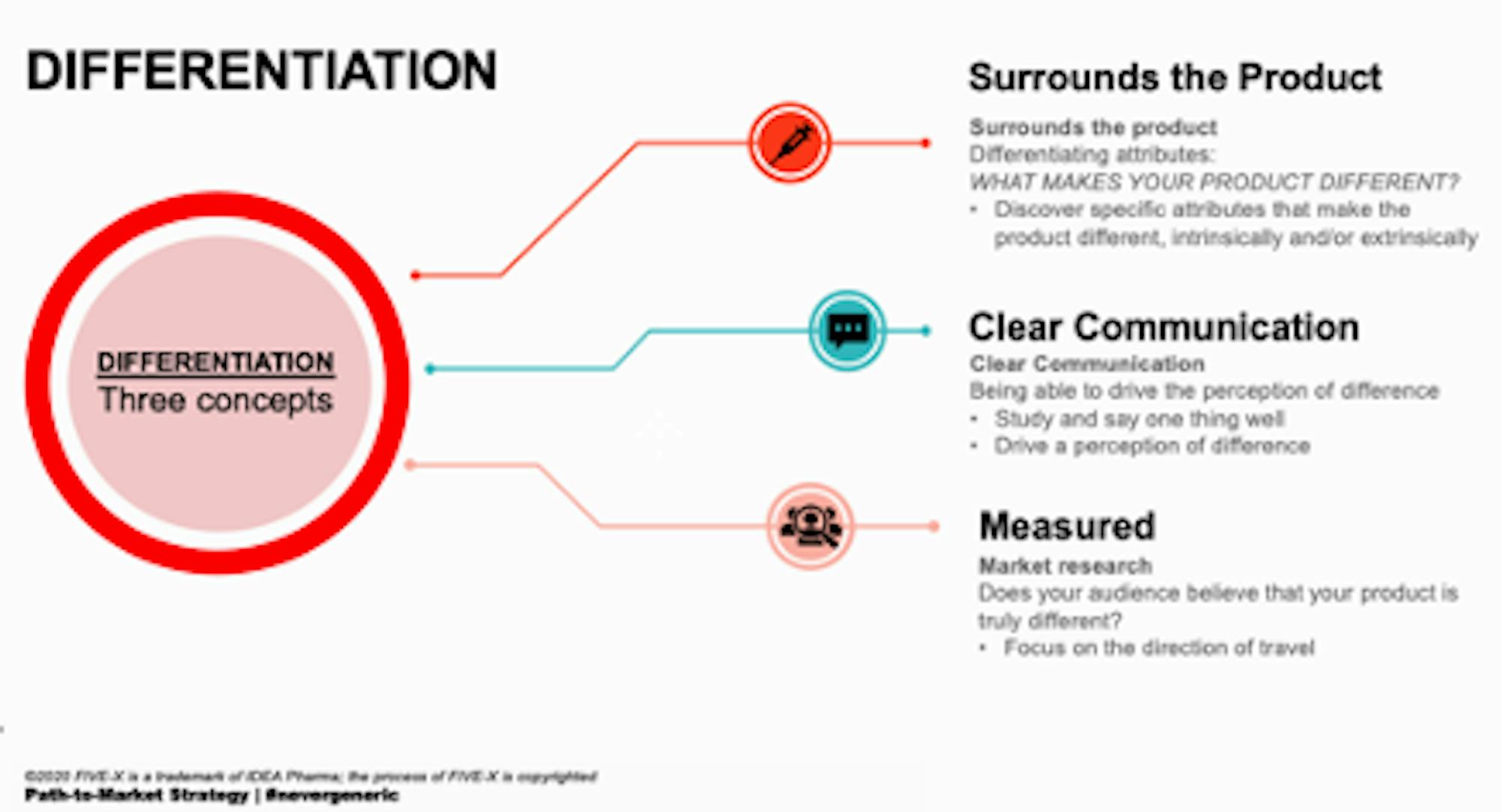
IDEA Pharma has developed the discipline of FIVE-X to help companies pursue all of the upside opportunities described in the previous paragraph. Though FIVE-X cannot address all of the challenges associated with reengineering clinical development we co believe that it can serve as an innovative platform for a new strategic approach for the management of assets in the early stages of clinical development.
Subscribe to our newsletter for more insights.
Further reading
-
Announcement
Positioning Matters
One of the most exciting parts of the pre-launch of a biopharmaceutical product is deciding what it is, and what we want our customers to believe over time.
-
Announcement
Humira – a story of how positioning helped build a ‘pipeline in a product’
AbbVie's Humira (adalimumab) is a brand that has outperformed its market by some margin. If there are a select few drugs which exemplify meaningful innovation, then Humira must rank near the top.