
As global franchises go, Humira's is as big as Burger King. Or, to contextualise that another way, that figure is almost three times more what Abbott Labs paid back in 2000 for the entire BASF/Knoll business, including the early Humira programme, or D2E7 as it was known then. Abbott needed a blockbuster. It ended up with a success story that that might eclipse Lipitor (atorvastatin) as the world's most commercially successful brand ever.
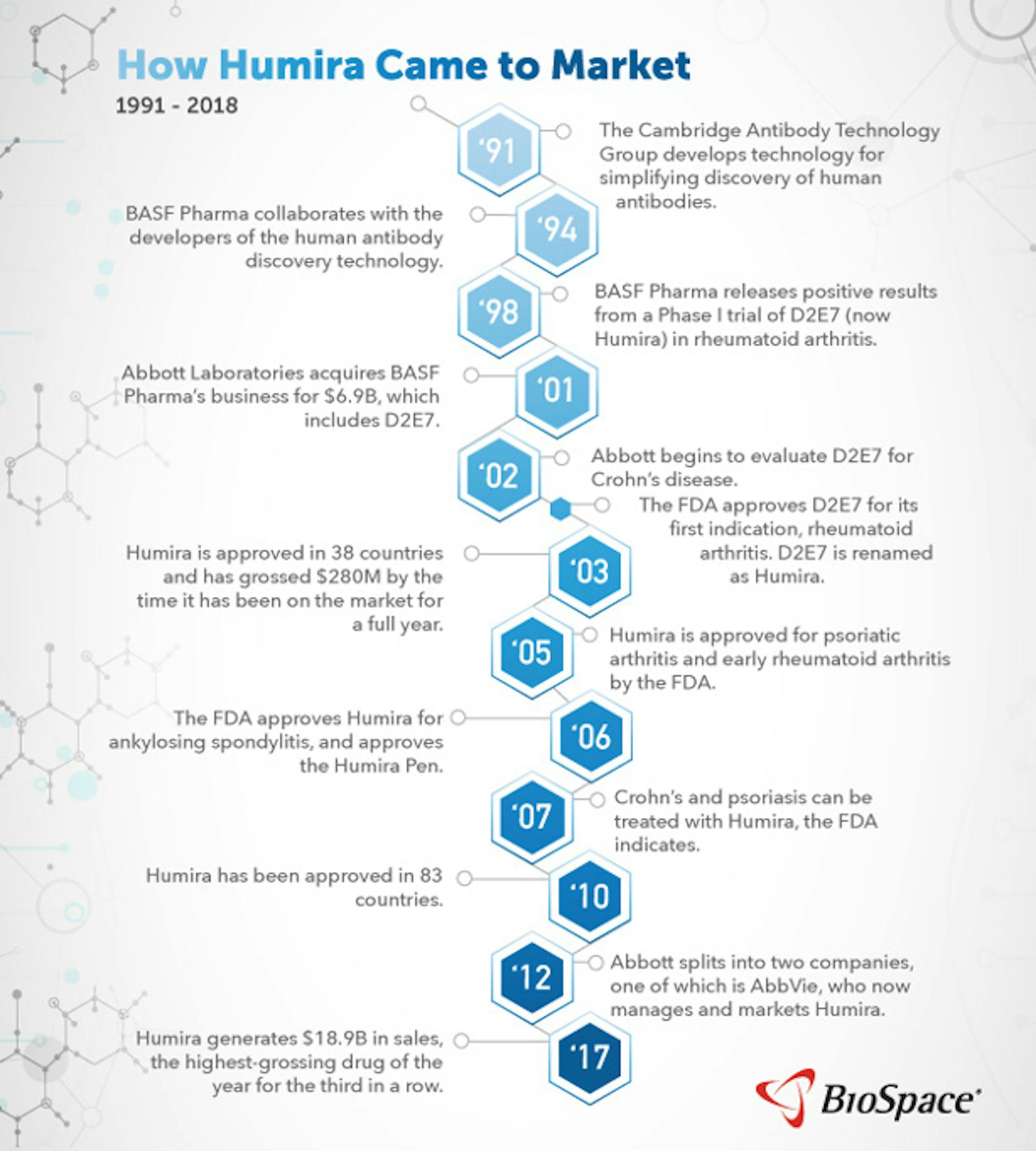
BioSpace, December 2018: A Look At Miracle Drug Humira’s Journey to Proven Efficacy
For those of you perhaps less aware of what Humira is, it's an injectable monoclonal antibody drug therapy that targets TNF-alpha, one of the primary pro-inflammatory mediators in the human body. TNF-alpha is considered one of the root causes of many immune-mediated diseases and a key driver of pathologic inflammation in the human body.
While Humira gained its first-ever approval back in 2002 for rheumatoid arthritis, Abbott had already seen beyond a 'one shot, one goal' opportunity and had a broader vision for Humira as a franchise and pursued the goal of building a blockbuster by generating a pipeline around a single asset. Tremendous lifecycle potential aside, the 'pipeline in a product' approach also helped Abbott avoid the technical and regulatory risk associated with bringing other new pipeline drugs through to market. By 2003, Abbott had laid their cards on the table, "the potential for expansion is significant; each additional indication represents a several-hundred-million-dollar market opportunity." Impressive data, regulatory submissions and approvals rapidly followed in multiple indications. At the time of writing, Humira has accumulated approvals for ten indications (including plaque psoriasis, psoriatic arthritis, ankylosing spondylitis, early and juvenile RA, juvenile idiopathic arthritis and Crohn's disease), far more than any other brand in the space.
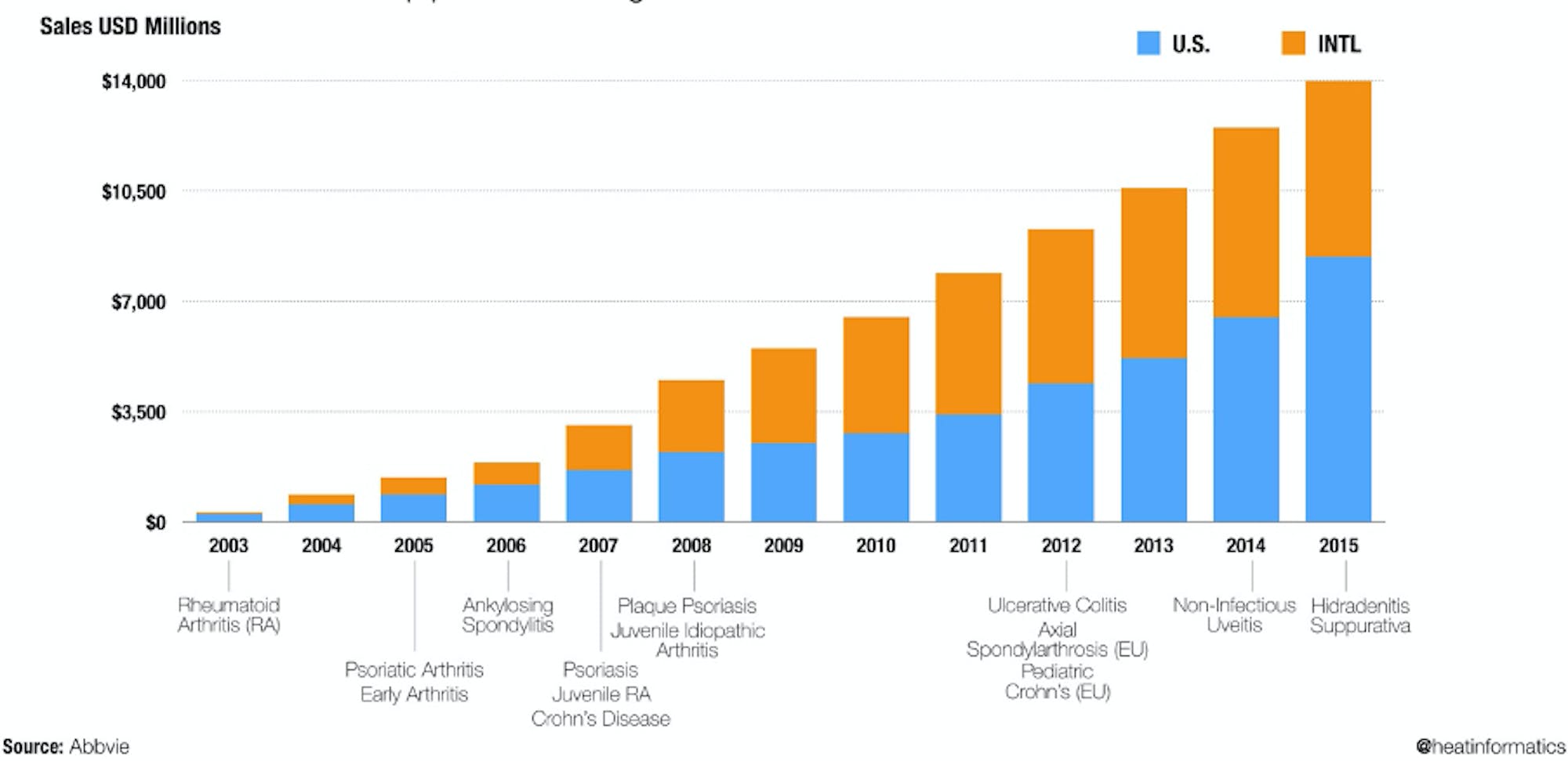
At the time of its launch, Humira was the third TNF-alpha inhibitor to market after Immunex's Enbrel (etanercept) and Centocor's Remicade (infliximab). Together they had built a near $2 billion head start. All three drugs in this class are considered to have roughly equivalent efficacy and price. Humira is deemed to have better tolerability, mode of administration and dosing schedule. However, the medical community has for the last decade or so largely consigned all biologics including Humira into the same category, meaning that all biologics are considered roughly equivalent and deliver the same value proposition. It, therefore, begs the question: how on earth is it that Abbott/AbbVie was able to overtake and outpace its nearest competitors by such a vast margin and stay there?
"Success has many fathers", and with Humira, and many of these factors are well documented:
– significant and sustained investment in clinical development across multiple indications
– costly long-range efficacy studies that could build superior data sets and demonstrate health system savings
– continuous engagement with the patient and healthcare community to deeply understand the needs and goals of different stakeholders and how to communicate back a simple but powerful proposition
– huge spend on promotion. According to FiercePharma in 2016, Humira ranked first several years running for the highest dollar amount of promotional spend than any other brand
– intensive and unwavering defence of IP with over 240 patent filings being submitted to the US alone by 2018
– regular price increases. According to some estimates, in the US the Medicare spending for Humira tripled, up 224% from 2011 to 2015, reflecting a 79% increase in unit price
– lack of follow on competitors willing to invest in a completely different path to market approach, so many have followed in Humira's footsteps hoping to be quantitatively different
These things helped, but one thing stood apart and drove Humira's performance. Its positioning. Abbott saw an opportunity early after the BASF/Knoll acquisition to build an active positioning which connected Humira's lifecycle indications. One critical insight Abbott leveraged quickly was that the majority of autoimmune and inflammatory disorders are multifaceted and systemic, affecting multiple organs. These are known as extra-articular manifestations (EAMS). Abbott understood that it could build a perception of broad benefit in not just addressing the symptoms associated with the core disease but also a broad spectrum of EAMs "inside and out" and in so doing, a provide a sustained effect on the whole disease and the potential for lasting benefit.
"Humira can give prescribers the possibility to change the course of the disease for their patients. With the lasting transformational power of Humira, prescribers can treat a broad range of indications, control symptoms with sustained remission and help patients to start feeling human again. In clinically appropriate patients, Humira can often be the first step to helping patients kick-start a positive chain of events that restore and create new possibilities".
Abbott's pursuit of this strategy meant new indications followed a logical, sequential pattern of accumulating evidence to support the proposition and also working closely with regulators to identify in advance what evidence was needed to drive a favourable outcome. Humira's positioning also created a potency which pulled through into the 'Count Me In' and 'Destination You' campaigns that communicated that only Humira actively enables more patients to get on with their lives, restore life's spontaneity and possibilities. Humira's positioning helped it to create a strong emotional connection with its customers, and unprecedented equity and loyalty which no other direct or indirect competitors have been unable to achieve then or since.
Humira (and many other star performers) tell us that positioning matters a great deal. These cases also tell us that getting the positioning right early, doing it actively and strategically can mean the difference between a promising drug that delivers against the commercial ambition of the originator and a genuinely great medicine that transforms the space and the lives of patients.
Subscribe to our newsletter for more insights.
Further reading
-
Announcement
Don’t Want to Eat with the Suits
Why Pharma Needs to Deconstruct the Stage-Gate Culture of New Product Development
-
Announcement
Culture of innovation Part II
At this time of global crisis caused by the Covid19 pandemic, let's look again at what our industry can learn about innovation from previous global crises – such as the first and second World Wars.