Let's look first at differentiation
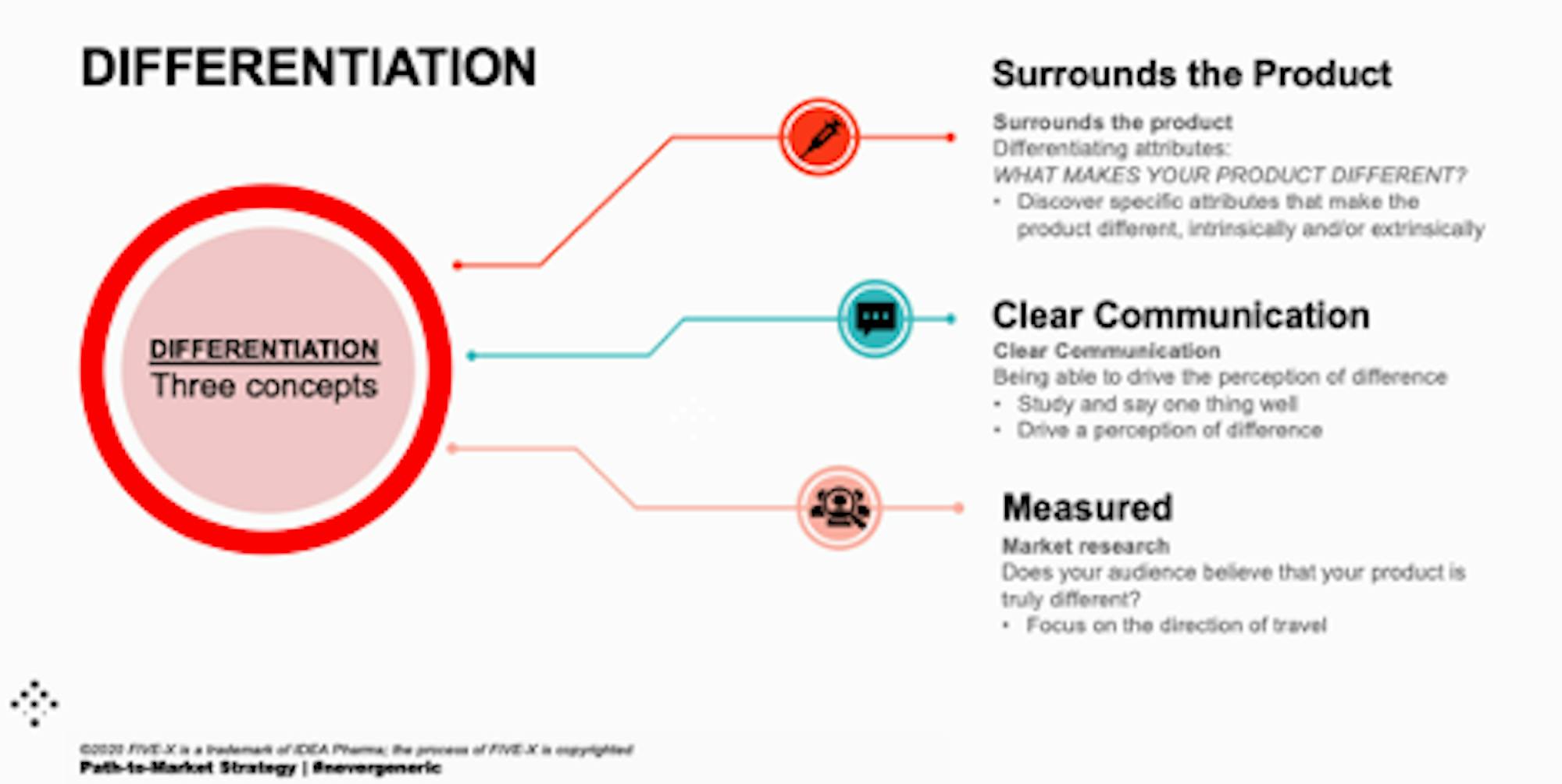
The word differentiation creates a challenge. There are three concepts involved: differentiation, differentiation and differentiation. Differentiation enables differentiation, which leads to differentiation.
The first 'differentiation' surrounds the product. It needs an examination of its differentiating attributes: a typical question would be 'what makes you different'? Not a surface skim ('it's once a day, that means convenience, right?), but a deep treasure hunt looking for those attributes that truly make it different (either as a molecule, or potentially as a brand). It is the hunt for the intrinsic or extrinsic difference.
The second 'differentiation' relates to differentiating through clear communication. That is, choosing to focus on studying and saying one thing well and driving a perception of difference. This 'differentiation' is the demonstration of difference.
The third 'differentiation' is the measured differentiation (do audiences understand, believe and echo the hoped-for differentiation). That is, do your audiences understand your 'differentiation' story? This 'differentiation' is the perception of difference.
Of course, none of these aspects of differentiation is self-evidently a good thing. It is incredibly easy to be differentiated (on items you'd rather not be distinguished by). Every product is a set of positive and negative attributes. If you are genuinely inventive, you might succeed in turning a negative into a positive (see McDonald's from 'Super Size Me' to 'Every Step Counts' or Viagra for examples), but more often products become 'differentiated' by their safety profile, formulation problems or lack of a certain kind of efficacy.
The challenge is to find the perfect combination of the thing/things your audience wants and that you are or do better than any other product.
Differentiation, as a process, should begin with an assessment of the kind of difference audiences want to see.
Do they want what they currently have, but better ('sameness with a difference'), or something different?
Unfortunately, much market research tends to produce the former – "we would like to be like what we have, but 10% better on this dimension, while not doing anything worse."
This kind of 'differentiation' is quantitative differentiation – the product is 'differentiated' only by being slightly or somewhat better numerically than its opponent.
More useful is 'qualitative' differentiation. Qualitative differentiation means finding something that the product 'does' that no other product does. That can look a lot like quantitative differentiation but is more powerful.
Do they want what they currently have, but better ('sameness with a difference'), or something different?
Unfortunately, much market research tends to produce the former – "we would like to be like what we have, but 10% better on this dimension, while not doing anything worse."
This kind of 'differentiation' is quantitative differentiation – the product is 'differentiated' only by being slightly or somewhat better numerically than its opponent.
For example, the difference between dropping LDL levels by 5% over the competition and getting patients to a tipping point that starts to reverse atherosclerosis might be no difference at all numerically, but one sounds a whole lot more valuable than the other. Unfortunately, many biopharma propositions fail to make this step towards a concrete, qualitative proposition – what does a 25% increase in PFS mean to a physician or patient, or what does a 4 point increase in ADA-Cog achieve for an Alzheimer's Disease patient for example?
Subscribe to our newsletter for more insights.
Further reading
-
Innovation
CNS Summit Innovation Index 2020
The CNS Summit Index examines the effort & investment that pharma companies put into the pursuit of innovation. Ranking by scale, impact, and 'innovativeness', of these efforts across 3 dimensions: digital, clinical trial optimization, & partnerships.
-
Announcement
Don’t Want to Eat with the Suits
Why Pharma Needs to Deconstruct the Stage-Gate Culture of New Product Development