
There have been changes, challenges, and opportunities across all segments of the healthcare industry. Which of these changes, individually or in combination, has the most significant impact will remain to be seen. Some of these changes impact macro-dynamics whose trend lines have or will experience an inflection as a result of the pandemic. While trends are often easy to spot and measure, it is always difficult to predict when their effect will reach a tipping point. The COVID-driven inflections for three trends may prove to have significantly accelerated the need and demand for change. These are the ability to pay for healthcare, the harsh demographic realities of our nation's health, and the need and desire for a more sophisticated and enabling digital system to support our health. All of these trends have expanded in magnitude and visibility.
Financial Drivers – Follow-the-Dollar
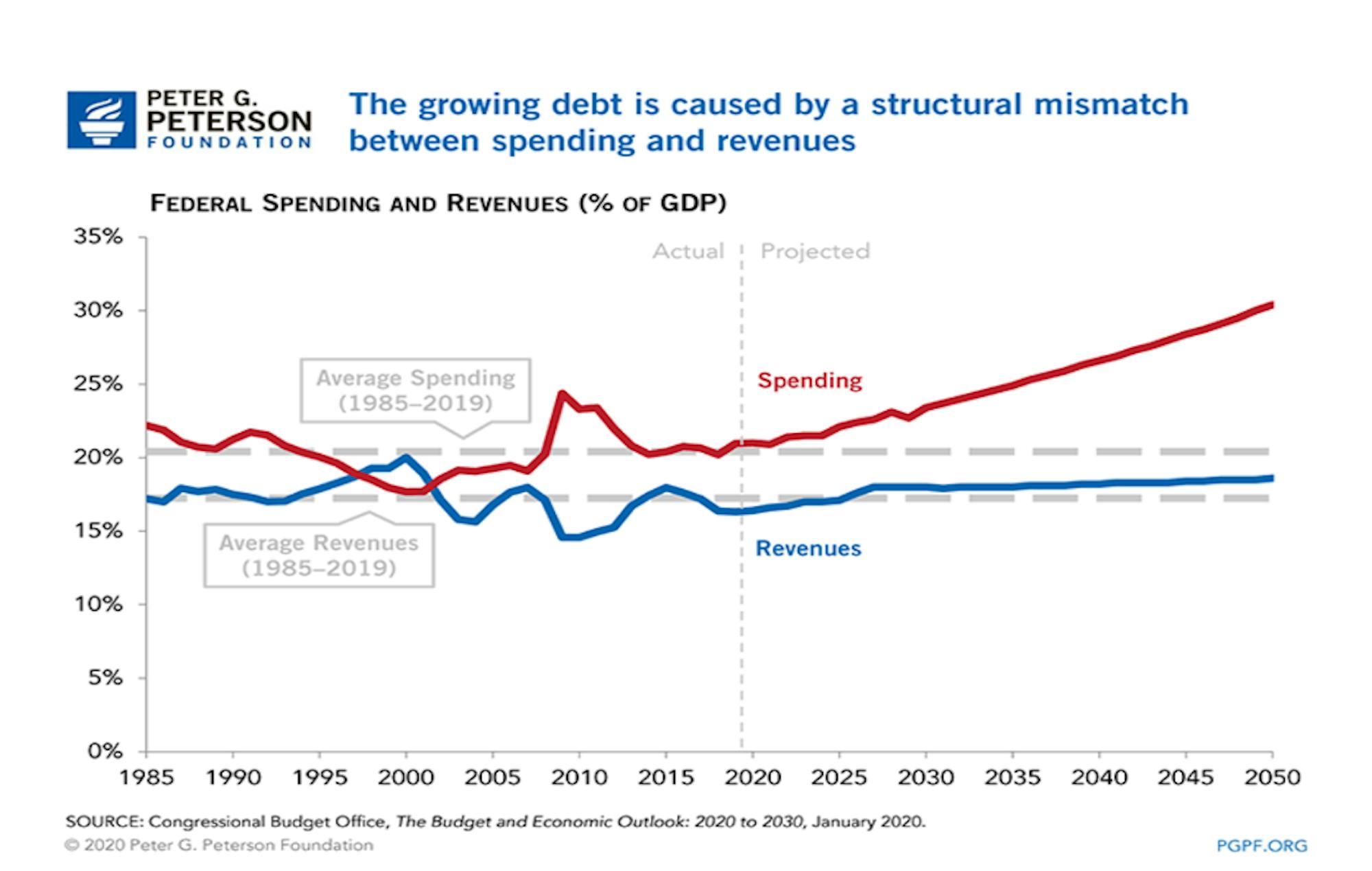
A few months back, financial pundits were discussing whether the impact of COVID-19 would produce a "V" or a "U" or even a "W" in terms of the shape of the economic impact of the pandemic. Though it has not officially been declared a recession (defined by two-quarters of economic decline), the U.S. Bureau of Economic Analysis' second estimate places GDP growth in the first quarter at -5.0% and most estimates for the second quarter decline involve double digits. In response to the economic challenges we now face, the Federal Government has passed the most substantial financial stimulus package in U.S. history. How could this impact the future of healthcare? Figure 1 below is an estimate of our U.S. Federal debt published by the Congressional Budget Office on March 12th, before the passage of the aforementioned stimulus package. Figure 2 is a forecast of the widening gap between Federal tax revenues and expenditures completed in January of this year. The top 3 drivers of growing expenditures are the aging population, rising healthcare costs, and the cost of our debt. How will these curves change when we add in the trillions of dollars of new debt and the incredible costs of caring for COVID-19 patients that were disproportionately represented by the elderly (Medicare) and the poor (Medicaid)? These changes need to be added to the shrinking ratio of the number of adults less than 65 years of age to those over 65.
When one considers the global cascade of economic effects from the pandemic, it is difficult to imagine that anything short of a miraculous recovery will overcome this economic shock quickly. The U.S. could be entering a protracted slow-down with a debt burden not seen since WWII and demographic trends that do not support less spending or higher income.
Figure 1.
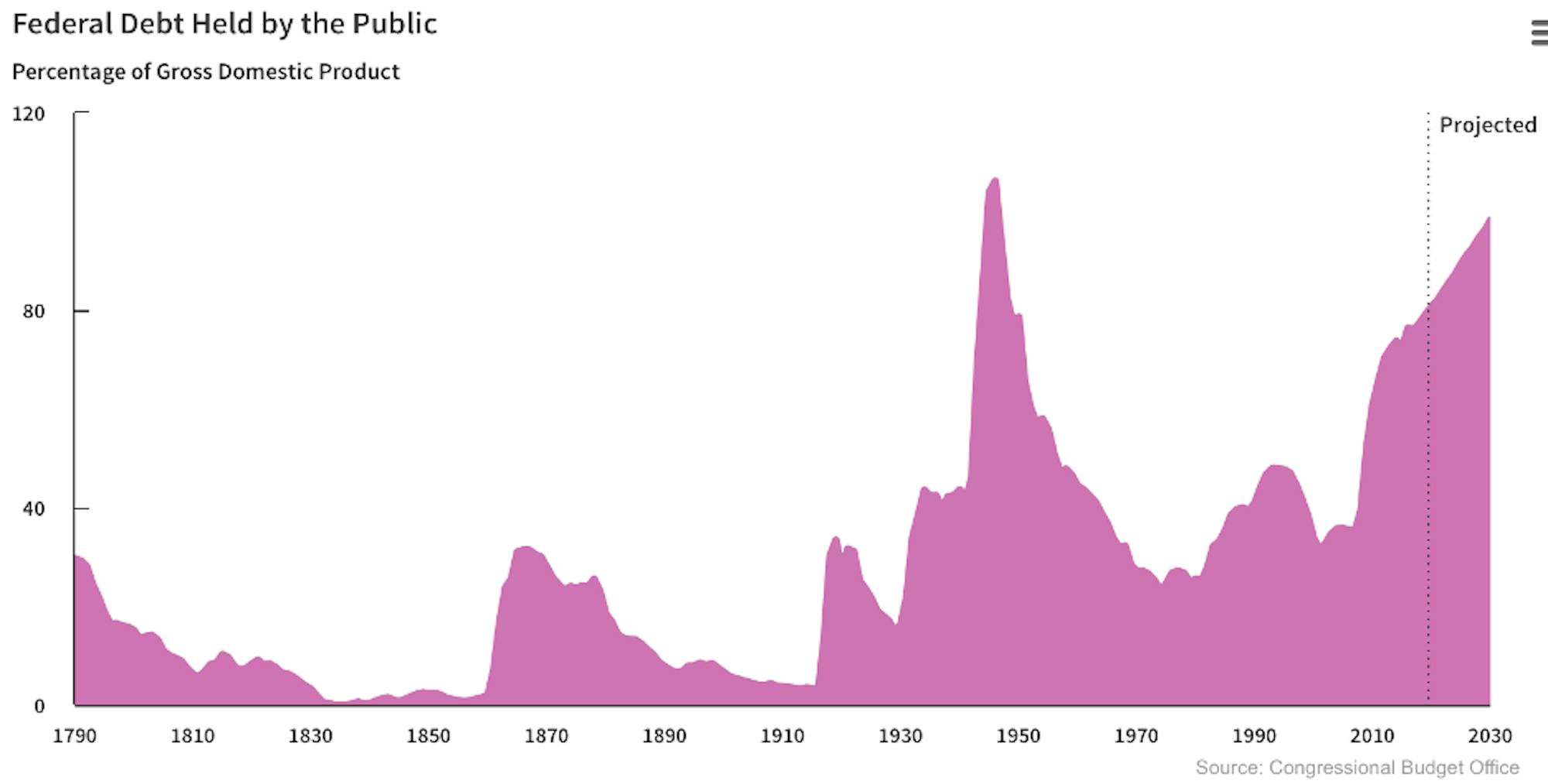
Figure 2.
Demographic Trends – Existing and New, More Visible Realities
The aging of the U.S. population is not new news. The fact that older American adults are in poorer health is also not new news. The fact that the majority of adults at or near retirement age have little to nothing saved for retirement completes a very sad demographic triumvirate. The combination of those harsh realities was clearly seen in the epidemiology of the pandemic. On June 15th, the CDC released their Morbidity and Mortality Weekly Report that analyzed the COVID-19 case surveillance covering cases from January 22nd to May 30th of 2020.1 The findings were as follows:
The cumulative incidence of those 80 years of age or older was over twice the general population and almost 2X the next lower age segment of 70-79.
The most common, exacerbating, underlying health conditions were cardiovascular disease (32%), diabetes (30%), and chronic lung disease (18%).
Hospitalizations were 6X higher for those with underlying health conditions, and death was 12X higher in this same population. (Both differences compared to those without underlying health conditions.)
Severe outcomes increased with age and underlying health conditions.
Minority populations were also disproportionately represented among those who were infected, hospitalized and died as a result of the virus: 33% of persons were Hispanic, 22% were Black, and 1.3% were AI/AN; these groups, who account for 18%, 13%, and 0.7% of the U.S. population, respectively, are disproportionately affected.
This final bullet is especially ugly in the wake of the civil unrest that started with the death of George Floyd. Additional analysis on the demographics of the COVID-19 pandemic conducted by MIT researchers revealed that counties with a Black population above 85% had a death rate 10X higher than the nationwide average county-level death rate. When controlling for all other possible factors (income disparities, lack of health insurance, health conditions, smoking rates, etc.) Blacks still had higher death rates from COVID-19. This raises the question of systemic effects of race on the quality of insurance and the quality of care.2
America is facing a demographic crisis in healthcare on two fronts. First, racial disparities in healthcare and health outcomes highlighted in the previous paragraph. Second, the "Silver Tsunami" of the aging, sicker, and more impoverished population. Both crises could benefit from population health approaches, preventative medicine, and actions that address the social determinants of health. These initiatives are difficult to support and implement in a predominantly fee-for-service healthcare vertical.
Technology – The Telemedicine Genie is Out of the Bottle and EHR 2.0
The technology lever is represented by two different, but highly interrelated occurrences during the COVID-19 crisis, The first, is the expansion of telemedicine that demonstrates the ability of the healthcare ecosystem to deliver care through a new, and more efficient channel. The second is the known, but now grossly more obvious, need for healthcare to embrace and invest in digital transformation fully.
Telemedicine
Beginning March 6th of this year, Medicare expanded coverage for beneficiaries to receive healthcare services via telehealth. At the same time, HHS waived enforcement of HIPPA for telemedicine, and the DEA loosened e-prescribing restrictions for controlled substances. State governments have also expanded access to telemedicine services for their Medicaid recipients. Not surprising, private insurers followed the lead of the Federal and State governments, and many have broadened coverage of telemedicine and expanded their telemedicine provider networks.3
On the provider side, more health systems are putting in place telemedicine programs, and as of April, an American Well survey found that 1 in 5 physicians are using telemedicine, and of those currently using the technology, most see their utilization of the channel increasing. Of those not now seeing patients via video, over half envision this changing soon. Physicians presently using telehealth see advantages for both the patient and the provider. Almost all believe it expands access to care. Both patient and physician benefit from greater convenience/efficiency of care, and it does and will reduce costs.4 Given the shortage of physicians and the unfortunate pervasiveness of provider burnout, any efficiencies would appear to be a plus.
Almost all patients who have experienced a telemedicine visit with a healthcare professional were satisfied with the experience. Patients do not need to miss work for an appointment. The average visit lasts less than 20 minutes and wait times are significantly shorter than in a face-to-face environment. The majority of Americans surveyed have expressed an interest in accessing care through telemedicine, and a doctor's ability to provide service through a video channel can be the basis for physician selection.5
All stakeholders acknowledge that there will be issues to be resolved with telehealth and that there will be a learning curve related to when it is appropriate and the best channel for care. It is also easy to envision other digital health technologies being wrapped around the virtual visit and being more seamlessly integrated for both the patient and physician. At this time, CMS has defined the expanded reimbursement of these services as temporary. Given all the benefits, it seems unlikely that telemedicine will return to its pre-COVID levels of utilization.
Electronic Health Records 2.0
It's hard to believe that in 2010 only 50% of office-based physicians had an EHR, and about half of those only had the most basic of systems.
At the same time, only 15% of hospitals had even a basic system. While it is very encouraging that for both physician practices and hospitals, these percentages run closer to 100% in 2020, the COVID pandemic has laid bare the inadequacy of these systems to support true health management. In a recent Harvard Business Review article, John Glaser, the former CIO of Partners Healthcare and former CEO of Siemens Health Services, put forward his recommendations for what needs to change in healthcare electronic records systems.6 At the heart of his argument is a crucial juxtaposition. He argues that our existing systems need to move from "transaction-oriented systems to intelligence-oriented" systems. He does recognize the need for documentation and transaction management, but he envisions systems that evolve from merely being able to generate a record, to dynamic systems that can create a plan. A plan for patient care.
Mr. Glaser acknowledges that such plan-centric systems will be of most value to those segments of the U.S. healthcare vertical that either have or are trying to move towards a value-based model. In summary, he states, "Achieving the intelligent, plan-centric health care platform will require a level of industry cooperation that is unlike, and in some ways antithetical to, the way we've always done things." 6
Conclusion
Will any or all of these trends drive more rapid evolution of the U.S. healthcare system to a value-based platform? Based on the acceleration and amplification of all these trends, one could assume that a world in which the majority of healthcare payments are made under some form of risk/outcomes-based contract will be with us sooner than one would have assumed at the end of 2019. The outcome of the 2020 elections will undoubtedly impact when change occurs in healthcare. The need for change in the face of the challenges captured in these trends appears to be irrefutable, but never underestimate the tenacity of the incumbent to maintain the status quo. Watch this space, and while you're waiting, make a video appointment with your doctor!
https://www.cdc.gov/mmwr/volumes/69/wr/mm6924e2.htm
https://www.statnews.com/2020/06/15/whos-dying-of-covid19-look-to-social-factors-like-race/
https://www.kff.org/womens-health-policy/issue-brief/opportunities-and-barriers-for-telemedicine-in-the-u-s-during-the-covid-19-emergency-and-beyond/
https://www.fiercehealthcare.com/tech/22-physicians-use-telehealth-and-burnout-may-drive-more-adoption-survey
https://blog.evisit.com/20-stats-how-do-patients-feel-about-telehealth
https://hbr.org/2020/06/its-time-for-a-new-kind-of-electronic-health-record